Overview
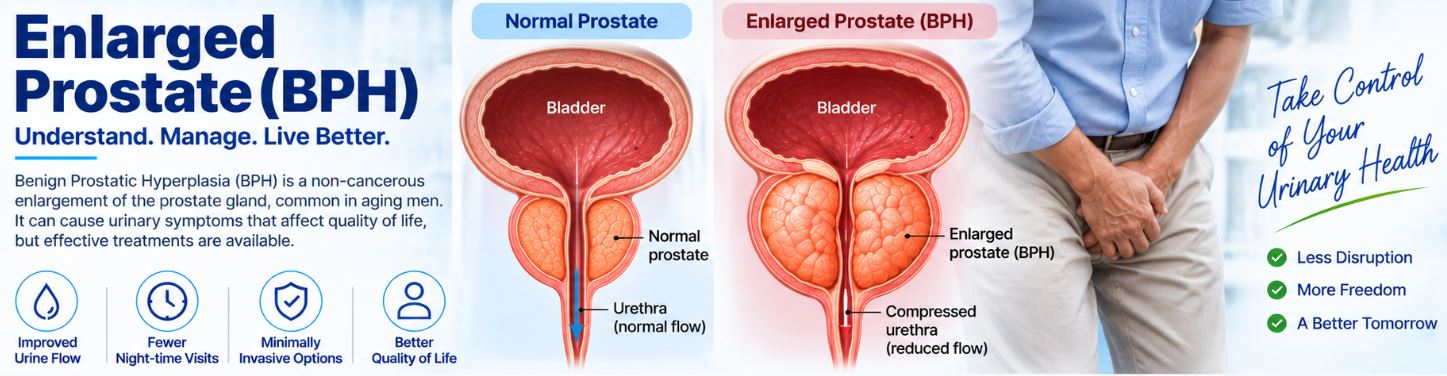
Benign Prostatic Hyperplasia (BPH) is a non-cancerous enlargement of the prostate gland that commonly develops with age. As the prostate enlarges, it can narrow the urethra and affect the normal flow of urine.
Symptoms can range from mild urinary inconvenience to significant difficulty passing urine. Treatment depends on the severity of symptoms, prostate size, urinary flow, bladder function and the patient's overall health.
Symptoms can range from mild urinary inconvenience to significant difficulty passing urine. Treatment depends on the severity of symptoms, prostate size, urinary flow, bladder function and the patient's overall health.
Common Symptoms
• Difficulty starting urination
• Weak or slow urinary stream
• Intermittent urine flow
• Feeling that the bladder has not completely emptied
• Increased frequency of urination
• Urgency to urinate
• Getting up frequently at night to urinate
• Dribbling after urination
• Inability to pass urine in severe cases
• Weak or slow urinary stream
• Intermittent urine flow
• Feeling that the bladder has not completely emptied
• Increased frequency of urination
• Urgency to urinate
• Getting up frequently at night to urinate
• Dribbling after urination
• Inability to pass urine in severe cases
Possible Causes
BPH is primarily associated with age-related changes in the prostate and hormonal changes that occur as men grow older.
Factors associated with BPH include:
• Increasing age
• Family history of prostate enlargement
• Hormonal changes associated with ageing
• Obesity and metabolic health factors
• Cardiovascular and lifestyle-related factors
BPH is not prostate cancer, although both conditions can occur in the same person and require appropriate medical evaluation.
Diagnosis
Evaluation begins with a detailed discussion of urinary symptoms and medical history.
Depending on the patient's symptoms, evaluation may include:
• Physical examination
• Digital rectal examination when appropriate
• Urine examination
• Blood tests
• PSA testing when clinically indicated
• Ultrasound assessment of the prostate and urinary tract
• Measurement of urine left in the bladder after urination
• Uroflowmetry to assess urinary flow
• Further bladder or prostate investigations when required
The evaluation helps determine the severity and likely cause of urinary symptoms and guides treatment selection.
Treatment & Procedures
Treatment depends on symptom severity, prostate size, urinary obstruction and the patient's individual circumstances.
For mild symptoms, lifestyle measures and regular monitoring may be appropriate.
Medical treatment may include medicines that relax the prostate and bladder outlet or medicines that reduce prostate size in appropriately selected patients.
When medicines are insufficient or complications develop, procedural treatment may be considered. Depending on the prostate and patient's condition, options may include:
• Minimally invasive BPH procedures
• Transurethral procedures
• Laser-based prostate procedures
• Endoscopic prostate surgery
• Other surgical approaches for appropriately selected patients
The most suitable treatment is selected after assessment of prostate size, symptoms, urinary flow and overall health.
Recovery & Follow-up
Recovery varies according to the treatment performed.
After a BPH procedure, patients may experience temporary urinary frequency, urgency or mild discomfort while the urinary tract heals. A urinary catheter may be required for a short period following some procedures.
Follow-up is important to assess urinary flow, symptom improvement and bladder emptying. The timing and type of follow-up depend on the procedure and the patient's individual recovery.
Benefits
• Improvement in urinary flow
• Reduction in bothersome urinary symptoms
• Better bladder emptying
• Reduced urinary obstruction
• Improved quality of life
• Reduced risk of complications from persistent urinary obstruction
• Multiple treatment options based on individual prostate and patient characteristics
• Reduction in bothersome urinary symptoms
• Better bladder emptying
• Reduced urinary obstruction
• Improved quality of life
• Reduced risk of complications from persistent urinary obstruction
• Multiple treatment options based on individual prostate and patient characteristics