Overview
Kidney stones are hard, mineral-based deposits that form inside the kidneys when certain substances in the urine become concentrated and form crystals. Stones can vary in size and may pass naturally through the urinary tract, while larger stones can become lodged and cause pain, bleeding or urinary obstruction.
Treatment depends on factors such as the size and location of the stone, symptoms, urinary blockage, infection and the overall health of the patient. A urologist evaluates these factors before recommending observation, medical management or a stone-removal procedure.
Treatment depends on factors such as the size and location of the stone, symptoms, urinary blockage, infection and the overall health of the patient. A urologist evaluates these factors before recommending observation, medical management or a stone-removal procedure.
Common Symptoms
• Sharp or severe pain in the back, side, lower abdomen or groin
• Pain that may come and go in waves
• Blood in the urine
• Pain or burning while urinating
• Frequent or persistent urge to urinate
• Passing only a small amount of urine
• Cloudy or foul-smelling urine
• Nausea or vomiting
• Fever or chills, particularly when infection is present
• Pain that may come and go in waves
• Blood in the urine
• Pain or burning while urinating
• Frequent or persistent urge to urinate
• Passing only a small amount of urine
• Cloudy or foul-smelling urine
• Nausea or vomiting
• Fever or chills, particularly when infection is present
Possible Causes
Kidney stones develop when certain minerals and substances become concentrated in the urine and form crystals.
Common factors associated with stone formation include:
• Low fluid intake and concentrated urine
• High levels of calcium, oxalate or uric acid in the urine
• Certain dietary patterns
• Family history of kidney stones
• Previous history of kidney stones
• Recurrent urinary tract infections
• Certain metabolic or medical conditions
• Some medications
The exact cause can vary according to the type of kidney stone.
Diagnosis
Diagnosis begins with a detailed medical history, physical examination and assessment of symptoms.
Depending on the situation, evaluation may include:
• Urinalysis
• Blood tests
• Assessment of urine mineral levels
• Imaging of the urinary tract
• Ultrasound or X-ray when appropriate
• CT scan to determine the size and location of a stone and identify urinary obstruction
The evaluation also helps identify factors that may have contributed to stone formation and assists the urologist in selecting the appropriate treatment.
Treatment & Procedures
Treatment is selected according to the stone's size, location, composition, symptoms and whether it is causing obstruction or other complications.
Small stones may sometimes pass naturally with appropriate medical guidance and observation.
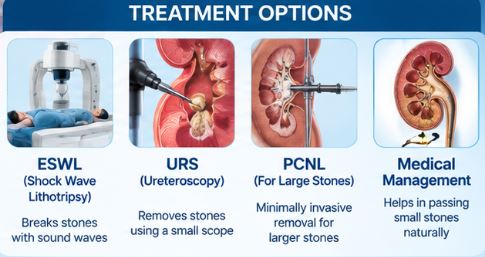
When intervention is required, treatment options may include:
• Medical management and observation for appropriately selected small stones
• Shock Wave Lithotripsy (SWL), which uses shock waves to break a stone into smaller fragments
• Ureteroscopy (URS), in which a small scope is passed through the urinary tract to locate and treat the stone
• Retrograde Intrarenal Surgery (RIRS) for selected kidney stones using a flexible ureteroscope and laser
• Percutaneous Nephrolithotomy (PCNL), particularly for larger or complex kidney stones, using access through a small opening in the back
The most appropriate procedure depends on individual patient and stone characteristics.
Recovery & Follow-up
Recovery depends on the size and location of the stone and the treatment performed.
After a stone procedure, patients may require follow-up to confirm successful stone clearance and ensure normal urinary drainage. A temporary ureteral stent may sometimes be used after a procedure when clinically appropriate.
For patients with recurrent stones, further evaluation may help identify the type of stone and factors contributing to recurrence. A urologist may recommend urine and blood testing and, in selected patients, 24-hour urine evaluation.
Follow-up advice should always be individualized according to the patient's condition and treatment.
Benefits
• Relief from stone-related pain and urinary symptoms
• Removal or fragmentation of problematic stones
• Relief of urinary obstruction when treatment is required
• Minimally invasive treatment options for appropriately selected patients
• Reduced risk of complications associated with persistent obstruction
• Assessment of factors that may contribute to recurrent stone formation
• Personalized prevention and follow-up planning