Overview
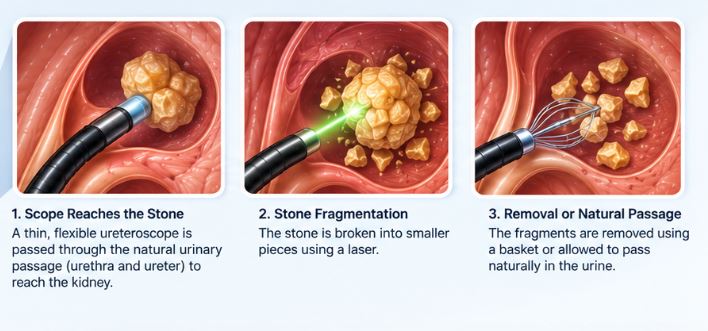
Retrograde Intrarenal Surgery allows the surgeon to reach stones located inside different areas of the kidney through the natural urinary passage. A flexible ureteroscope provides a clear view of the kidney and laser energy can be used to fragment stones into smaller pieces or dust.
Common Symptoms
Flank pain, blood in urine, recurrent urinary infections, nausea, urinary discomfort and sometimes no symptoms.
Possible Causes
Kidney stones may develop due to dehydration, dietary factors, metabolic abnormalities, family history and recurrent urinary infections.
Diagnosis
Evaluation may include urine and blood tests, ultrasound, X-ray and CT imaging to determine stone size, location and kidney anatomy.
Treatment & Procedures
A flexible ureteroscope is passed through the urethra, bladder and ureter into the kidney. The stone is identified and fragmented using laser energy. A temporary ureteric stent may be placed when clinically indicated.
Recovery & Follow-up
Recovery is generally relatively short. Temporary urinary frequency, discomfort or blood in urine may occur. Follow-up depends on the stone burden and treatment response.
Benefits
No external incision, flexible access to the kidney, precise laser stone fragmentation and minimally invasive treatment.